Hi,
In the last email, I challenged you to develop a constructional program for Blondie that would allow me to play with her at liberty.
To help with that, we use Goldiamond’s four questions:
- 1. Wohin willst du von hier aus gehen?
- 2. Wo stehst du jetzt?
- 3. Wie kannst du dorthin kommen?
- 4. Was hält dich motiviert?
I am curious, what does your training plan look like? If you feel like sharing it, send me an email. I would love to learn about your idea.
This email will describe my training choices for the first two questions.
The following questions will take a little longer to elaborate on and will be developed over the remaining emails in this series.
Ready?
Let’s start with the first question.
1. Wohin willst du von hier aus gehen?
When people are asked about what they want their horse/dog/spouse/child to do, they tend to describe the absence of the problem instead of an observable outcome. “If he would just stop doing this.”
To solve this, Goldiamond suggested the following metaphor:
“Imagine Martians were descending to study life on Earth. They follow you and your horse around and take note of their observations. What would they see you doing?”

“My Martian” would see Blondie entering the arena, stepping on her mat, and waiting for my cue to start the training session. Blondie would respond to the signals I gave her until we ended the session; she rolled in the sand and then re-joins her equine friends.
2. Wo stehst du jetzt?
Establishing where you are now may take more effort than you imagined.
You may think you know the problem, but you might not yet know all relevant factors unless you go through a systematic process.
How far do you have to go back to find a behavior and location/setting where (a tiny part) of the desired behavior occurs?
A helpful but often overlooked question is: Where or when does the problem NOT occur?
Our problem occurs in the riding school; it does NOT occur in the paddock.
That answer is constructive because now I have a good training location.
The paddock is a very convenient solution because it is an area where Blondie is relaxed; it provides enough space. I can easily separate her from the other horses without her feeling separated. (They are right there).
Location ✅
I want to emphasize this point again because it may get overlooked.
So often, trainers try to “fix” a problem right where they encounter it. They do not consider changing the training environment even though it is easy to do.
Your horse is nervous and continuously moving left to right at the cross-ties? Then you may decide to train right there at the cross-ties shaping towards standing calmly? Ever done that? I sure have.
Don’t get me wrong. Good for you, choosing training over ignoring the nervousness. 👏 That’s fabulous.
But it would be way easier to build the skill of standing calmly at a place where your horse is relaxed and already can stand calmly for some time.
Then, when the behavior is more established, bring it back – in approximations – to where the problem has occurred initially.
Back to Blondie:
To develop a training plan (question 3), I need to define my starting point (question 2) that defines the training environment (paddock) and available repertoire.
Which behavior does Blondie already have in repertoire that I could use as a stepping stone for building the desired outcome: working at liberty in the arena?
What do you think?
I give you a hint: Blondie knows all six of Alexandra Kurland’s foundation lessons.
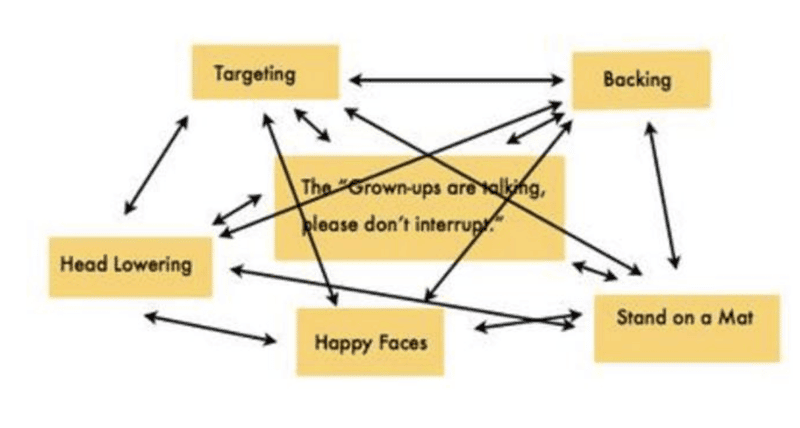
Which one would be useful and how? Hit reply and let me know.
In the next email, I will tell you which behaviour I chose.
Until then, enjoy your horses,
Michaela