Hi,
In this email, I want to look at two things: Feeding position and turns.
Where you deliver the treat is important.
Blondie and Malou are both Quarter Horses and they are very low in front. We want to be careful where we feed so that they don’t get even lower.
Graya, a PRE, has a much higher neck, and in her case, I may even decide to stretch her neck out a bit as I feed.
With Blondie, I remember how she initially pushed down on my hand when I offered the treat. I had to maintain a straight posture instead of falling forward following her lead. (Video is your friend).
But over the first year that I worked her consistently, she became a lot higher in the front compared to where we started, only by offering the treat in a “dressage-like” self-carriage position. (Again, video is your friend).
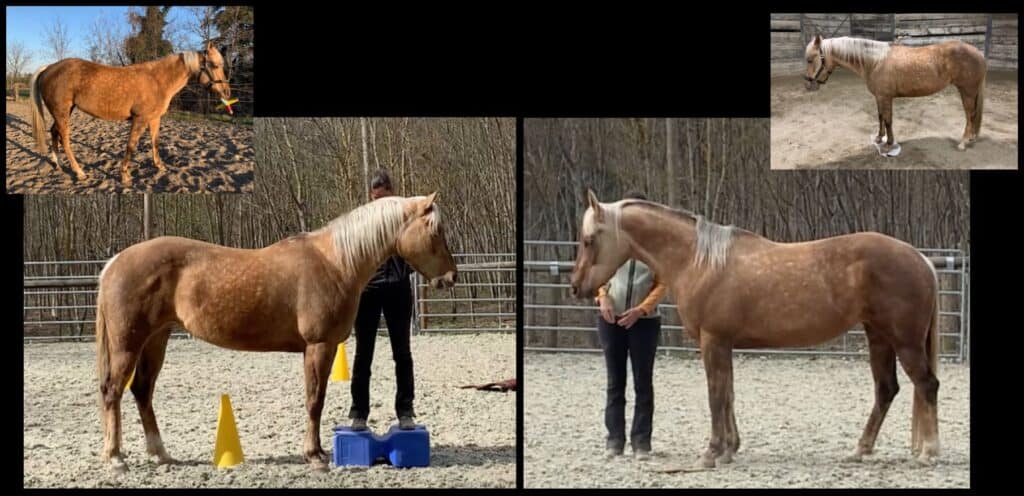
Malou was also quite low. I needed to remember to feed a little higher than where her nose was, so she can experience how it feels to be more balanced over her four feet.
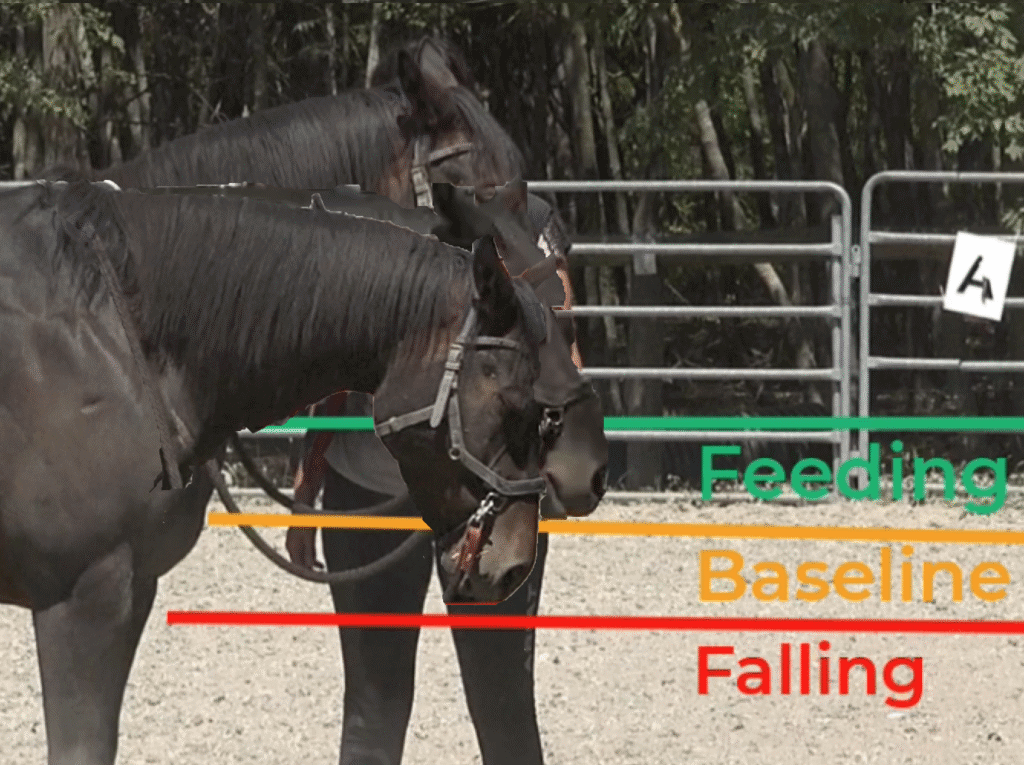
Be careful not to offer the treat too high, though, or your horse may hollow its back. That’s not what we want. A good rule of thumb is to feed approximately at the level the tip of the chest at the start. Then adjust depending on what you observe.
Looking at the front legs from the side, you would ideally see them in a perfect plumb line to the ground. But often the shoulders are shifted a little further to the front and the front legs are not perfectly perpendicular. This means that the horse carries more weight on the front legs. In this case try to offer the treat a little further back. Not as much as cueing the horse to take a step back but only so much that the front legs are vertical.
I am working with Malou on softening to the inside rein. Notice how she has to lift her head in oder to take the treat. In the future, she will anticipate that the treat is delivered higher and lift it earlier and eventually carry her head higher. Blondie’s progression supports this.
Turns
Left and right turns can give you a lot of information about your horses’s crookedness and could potentially identify soundness issues.
A turn on your horse’s stiff side is probably more jerky and she will fall on her inside shoulder.
Preparing the turn with flexions will improve the quality of that turn immensely.
Turning at a slower speed helps your horse to place her feet and bend her joints (engagement). But if you go too slow, you loose forward, and she stops.
If you go too fast, she may swing her hind end around and come to a halt (disengagement).
How small can you make the turn without compromising quality? If the turn isn’t smooth, try making it bigger.
You are your horse’s guide in these turns and the quality of the turn is shaped by your own movements.
In clinics, Alex Kurland asks participants to walk around a cone (no horse involved). Walk around the cone in a left and right turn. Which one is easier for you? Go very slowly, then speed up and slow again. Make the turn very tight or more generous. How did that affect the quality of the turn? What happens if you bend your knees a little bit, slow down even more, and place your feet carefully. Can you even involve your hip in the turn? What’s the effect? What happens if you look to the outside as you turn to the inside? There are no right or wrong answers. Just explore with curiosity.
I have a few video examples with horses, but I am going to put them in the next email otherwise this email gets too long. I want to keep them at 700-800 words.
In the meantime, you can play with the walking / turning exercises.
Have fun,
Michaela