Hi,
The opposite exercise to “Backing in a Square” is the “Wall exercise”. In Backing in a Square, you ask your horse to take the head to the off-side and the hindquarters towards you. Whereas in the “Wall exercise”, you request a give or flexion to the inside and the hindquarters move away from you.
The use of the wall (of the riding arena) is an environmental arrangement to help you and your horse with the exercise.
Backing in a square is best done in a corner because the corner helps your horse find the answer. As backing in a straight line along the fence is no longer possible when you reach the corner, she has to step sideways to continue backing as requested.
The wall in the wall exercise helps to “collect the horse’s feet”. But let me first explain the lesson.
Alexandra Kurland’s Wall exercise teaches stepping laterally in a small half-circle at the wall. We assume that our horse is relaxed working close at the wall. If that’s not the case, you need a training progression to teach this, for example, use figure eights that approach and move away from the wall until she is comfortable.
To start the lesson, you stop your horse on the track parallel to the wall. You move to the outside, with your back to the wall, looking at your horse. Now pick up the lead rope, ask for a give. Next time you ask for a little bit more flexion, then a little more again until your horse lifts its inside hind leg (or the outside hind leg, depending on what you want to reinforce at that moment). You release, C/T and ask again. You continue until you reach the wall on the other side. Ask your horse to back 2-3 steps. Then you can repeat to the other side.
As your horse gets more fluid with this exercise, you can ask for multiple steps before C/T but remember to release the rope after each step. When you reach the wall, ask for an additional half step against the wall, this will really “tuck in” the hind legs.
Should your horse get a little too fluid and run away sideways, you can swap side and return her back to the wall.
You will notice that on the stiff side, it is easier to get the side step. On the hollow side you will get more “neck” before you get the “leg”. Once the horse understands what you’re after, you can be more specific about the level of flexion you want.
Depending on how much bend you ask, you can use this lesson as a preparation for Anja Beran’s favourite lesson of Übertreten (overstepping) or, if you use more bend, as a preparation for lateral movement (e.g., into shoulder-in or haunches-in).
I like to use it for Übertreten, so I ask for a give but keep the neck straight. In that scenario, both hind legs open and close as the horse steps around you to reach the wall on the other side. And if you do it on a bigger circle, the shoulders also open and close. For Anja, this movement is a prerequisite for piaffe. In fact, with the wall exercise, piaffe steps may pop out.
It’s a very useful exercise, but don’t overdo it as it can be tiring. Blondie had lots of difficulties with this movement as she was so locked up in her body. Working on it consistently in small increment helped her to become more mobile and now she can do a full circle under saddle in a calm and (much more than before) balanced manner.
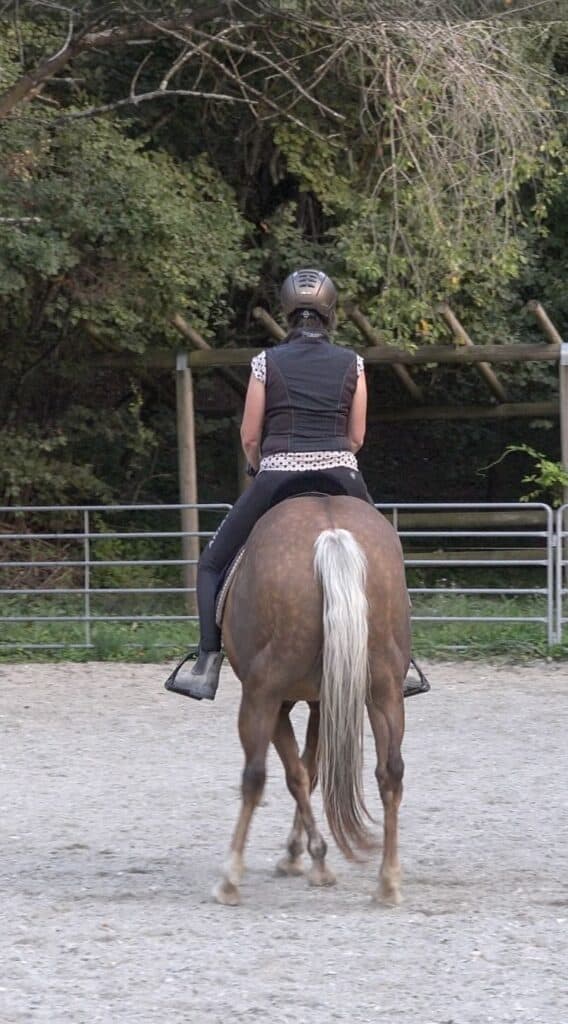
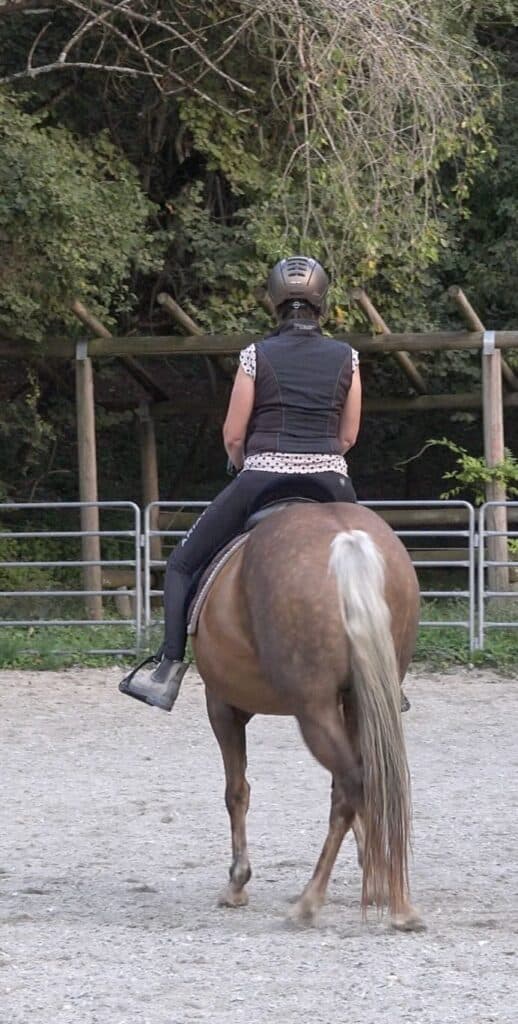
In the screenshots below, I capture Blondie in “Übertreten” on a circle from the right to left. You can see how both front and hind legs cross over in two subsequent strides.
Anja starts this lesson already with young horses, so I tried it with Malou. I believe, this was the second trial.
This is Blondie’s first trial with more flexion on her hollow side. I go with it because at some point, her leg will follow. You’ll see, that I am building it very carefully with her. The lateral step is a result of the flexion. She is deciding to take the step. I don’t go directly for the hip. That would have been too much more her.
Graya is an expert 🤩. You want to keep some control over the number of steps. If she is running away to complete the half circle before you even asked, try to interrupt, change side and ask her to rewind. It’s nice to have a fluid movement but it shouldn’t feel rushed. Obviously, you can also do only half way and back, just for fun. I have added a short sequence at the end to show that diagonal steps can pop out of this exercise.
The wall exercise is the perfect preparation for Übertreten, and ultimately for piaffe.
Who needs more reasons to try it?
Have fun,
Michaela