Hi,
Blondie was ridden regularly, almost every day, by her previous owner, for at least 3 years (that I witnessed), plus another 6-12 months at her breeder’s. I was told that the breeder didn’t keep her because her sliding stop had no potential. I don’t want to know what they do with a 2-year old to determine that.
When I took her, she had to stay another three months at that barn before I could move her. The people at the barn kept asking me when I would ride her. I always replied “when she is ready” which didn’t make sense to them because they have seen her ridden all the time.
You have seen Blondie’s baseline videos, you understand why I decided not to ride her.
In the first year, we had so many puzzles to solve. At some point, I asked her about the saddle and she said: No, thanks.
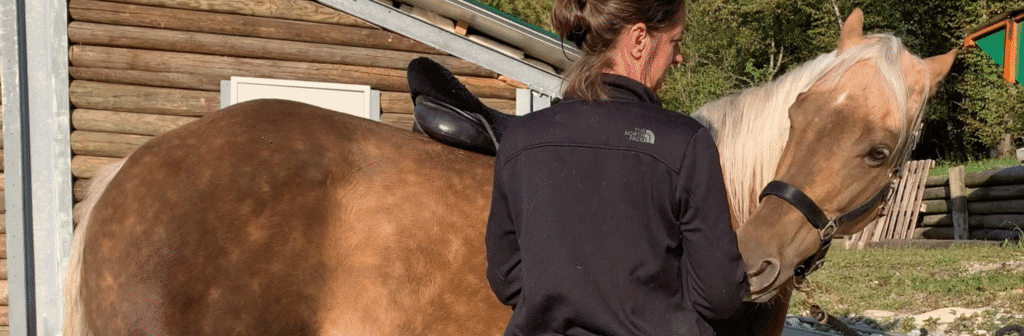
When people research reasons for their horse showing undesired behaviour that makes it difficult to put a saddle, the following causes are often suggested: poor saddle fit, gastric ulcers, “being a mare” and other labels put on the horse to “explain” the behaviour. Nobody ever admits that it may be the hander’s harsh saddling routine and that the horse’s defensive (or sensible) behaviour functioned to postpone e.g., the tightening of the girth.
I forgot about saddling for a while until I could dedicate specific training time for it. It ended up being a 5 week programme, at the end of which she was completely relaxed doing saddling.
A constructional saddling programme
Blondie’s training programme was built using the constructional approach. If you are not sure what this means, I suggest you start reading hier and the following two (hyperlinked) pages and, if not done already, subscribe to the Cone circle series by clicking on this LINK. This will give a better understanding of the constructional approach.
The programme included the following steps:
- Identify the stimulus conditions that control the behaviour
- Find an environment where behaviour occurs that you can reinforce
- Define your starting point and build new behaviour
- Transfer new behaviour to final environment
The behavioural tests with Blondie indicated that her responses to the saddle were learned and not organic (muscle sore or ulcers). She remained relaxed when I was next to her stroking her back, even applying pressure but as soon as I approached her carrying a saddle she became tense and started cribbing on the rope. When I placed a saddle on her back, she swiped at me. There was no girth, only the weight of the saddle.
It was pretty obvious that the presence of the saddle was causing her defensive response (step 1).
I decided to train in her paddock because that’s where she was the most calm and relaxed (step 2).
Those two steps were easy enough. Finding the starting point took a bit of experimentation. The criterion was that Blondie would stay as calm and relaxed during training as she typically is in this environment.
I needed to dismantle the saddle into parts that fulfil the criterion of staying calm and relaxed and I needed behaviours that would allow to gauge whether Blondie was still engaged and, in fact, relaxed. Those behaviours were targeting and going from mat to mat. Any hesitation, disengagement or behaviours to create distance were interpreted as criterion not met and changes were applied to the programme.
I am saying right away, that I will not present the entire programme in the coming emails. If I did, we would never get anywhere near riding because there is a lot of detail to it.
This email is already getting long and there was a lot of material in the previous emails. So I leave you with a video of the baseline behaviour at the start of the training and in the next email we’ll look at some of the training steps.
In this video, I am going through the entire process of saddling to get a baseline about how the behaviour looks like. This is not training but serves as comparison after training. FYI, at this point, I have not yet ridden Blondie.
You will see behaviours that we typically interpret as “uncomfortable”, “trying to get away”, and “tense”.
In the past, this behaviour was ignored. She was saddled and ridden anyway just like so many other horses. I came across a study that assessed “abnormal behaviour” (a term often used in studies that I find meaningless) during tacking up.
The authors report that:
“Only 3.1% (n = 6 of 193) of horses exhibited either no abnormalities or exhibited abnormalities for less than 5% of the time they were being tacked-up, which was considered ‘normal’ behaviour.” (Dyson et al., 2021)
That’s how common it is that the horse’s response is ignored, in the sense that they are tacked up anyway.
I leave you with this.
Michaela