
Hi,
As I write this email on January, 22nd, 2025, I have just returned from a fabulous week in Copenhagen. We had the kick-off meeting of an exciting project about developing methodologies to assess positive animal welfare using behaviour-analytic and ethological approaches. The project is lead by the Danish Technological Institute and the University of Copenhagen collaborating with Copenhagen Zoo and …drumroll… Dr Joe Layng and Dr Paul Andronis. That’s right!

On this occasion, Joe and Paul gave a lecture to a wider audience about the complexities of trying to understand behaviour – and it was brilliant!
From the many aspects that were discussed, let me just pick out one aspect that fits the context of this email.
Emotions as contingency descriptors
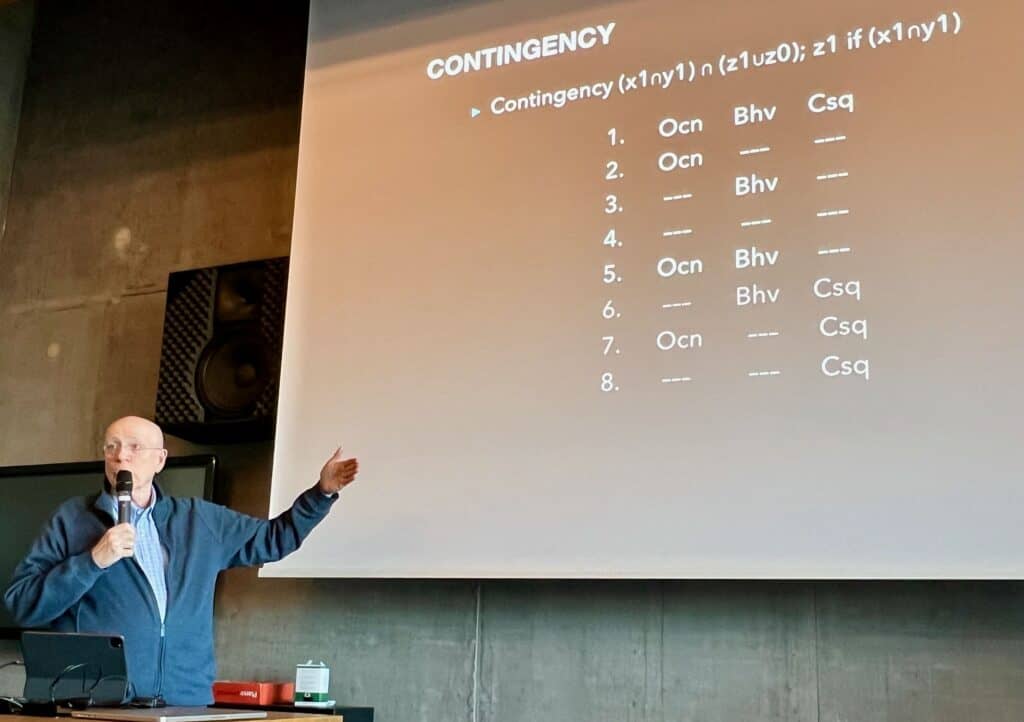
Joe talked about contingencies and emphasised that in order to understand emotions, you need to understand the contingencies that they reflect.
And only by changing those contingencies can you change emotion.
The best description of contingencies, that I have found so far, is provided by Joe and Paul and coauthors in their book Nonlinear Contingency Analysis.
During his presentation, Joe provided an example to explain the concept:
- A common cold occurs only when both rhinovirus and the nasal mucosa of a susceptible host are present.
- A nasal mucosa without exposure to rhinovirus does not result in infection, and similarly, rhinovirus cannot lead to infection without the nasal mucosa.
- Additionally, even when both elements are present, infection is not always occurring.
- If a common cold is observed, rhinovirus must have occurred in the presence of nasal mucosa of a susceptible organism.
Described in more general terms, in the case where a consequence is observed (common cold), both occasion (nasal mucosa) and behaviour (infectious rhinovirus) must occur; a consequence is present only if the behaviour has occurred in the presence of the occasion.
If a relation meets these requirements, then we say a contingency exists between occasion, behaviour and consequence and that the occurrence of a consequence is contingent upon the occurrence of a behaviour in the presence of an occasion (in short: a consequential contingency).
Blondie saddling project
Blondie was already ridden when I got her. Training the saddling and mounting block was not about getting her acquainted with this experience but changing the contingencies and thereby the emotions, that reflect these contingencies.
Whatever Blondie may feel around saddling is part of the consequential contingencies.
The baseline consequential contingency could be described as:
In the presence of a harmful stimulus (saddle), behaviour occurs that removes this stimulus (e.g. biting the person holding the saddle results in saddle removal), then this consequential contingency could be captured under the label of e.g., “Anger”.
To change emotions, you need to change contingencies.
The new saddling routine could be described as:
In the presence of the saddle, behaviour occurs that brings the saddle closer (approach), then this consequential contingency could be captured under the labels e.g., “Anticipation” or “Excitement”.
I could have saddled Blondie without major difficulty despite her pinned ears and swiping but I didn’t want to carry those negative emotions forward to the riding. It would have been much more difficult to build a relaxed “riding behaviour” on top of an “angry” saddling, if you know what I mean.
In the next email, I will switch to saddling the young and inexperienced horse.
Happy reading,
Michaela
P.S.:
For the serious readers, here’s Joe Layng article on Emotions as contingency descriptors.
2016_Joe Layng_Private Emotions as Contingency Descriptors. Emotions, Emotional Behavior and their Evolution.pdf