Hi,
The key to achieving the desired transformation is to be consistent around the fundamentals. Every small step contributes towards reaching your goal.
Remember the four questions of the constructional approach as formulated by Dr Israel Goldiamond?
- 1. Wohin willst du von hier aus gehen?
- 2. Wo stehst du jetzt?
- 3. Wie kannst du dorthin kommen?
- 4. Was hält dich motiviert?
These questions can guide you when making the next training decision. The answers to these questions help you design your overall goal, your ideal outcome but also the training programmes within the overall objective.
If the overall goal is to ride (answer to question 1) but your answer to question 2 is: my horse runs away when she sees me approaching with the saddle, then you can use the four questions to develop your training plan that brings you closer to your goal of riding.
Your proximate goal could be that your horse approaches you when you present the saddle and you design the shaping plan accordingly.
Now that your horse is happily targeting herself under the saddle, you revisit the 4 questions and decide on your next goal.
And if things don’t work out immediately, you modify the plan keeping the same goal in mind OR define another goal in case you are missing a component behaviour.
The important thing to keep in mind is that all the training you do will get you closer to your overall goal as long as you apply the fundamentals.
Alexandra Kurland developed “training mantras” to help us apply these fundamentals consistently. For example:
“If a training loop is clean, you get to move on. Not only do you get to move on, but you should move on.”
Keeping this in mind reminds us to move forward and not get stuck in training plateaus.
At the same time, when the training loop is NOT clean, we should not ignore it but make adjustments to our training.
Repeating the same unsuccessful training plan does not make it any better.
Dr. Jesús Rosales-Ruiz says:
“Don’t train on top of bad training”
If the loop is not clean, apply the second of the four questions, “Where are you now?”, to identify your starting point and rebuild the desired behaviour from a point of success.
We need to create the opportunity for the behaviour that we want to shape.
You can pull out the mat or a target stick if you want to create the opportunity for forward movement which you can then reinforce.
More often than you might expect, this opportunity is created by a shift in balance.
For example, you may want your young horse to stand calmly beside you waiting for your next forward cue, instead she walks off before you cue her (see email 10).
In order to create the opportunity to stand patiently next to you, you could feed her in a way that shifts her balance slightly backwards and you can change your way of standing and position towards her. These small changes of balance are likely to help her stand next to you until you are ready to move on.
Anja Beran uses the classical dressage movements to create the opportunity for the next movement.
For example, if a horse has a tendency to fall forward, in other words is not able to stand until cued to go forward, she may decide to frequently ask for halt and reinback.
On the other hand, if she wants to get a more expressive medium trot, she may first ask for overstepping or piaffe, which bends the joints and results in a stronger push forward in the medium trot.
Knowing how these lessons taught by Alexandra and Anja interact, gives you an impressive tool box to achieve your training goals.
Knowing also that training takes time, especially if you have a horse that has had bad experiences, takes off the pressure to expect quick results.
Think years, not weeks or months.
You will get there if you are consistent.
“Success doesn’t come from what you do occasionally. It comes from what you do consistently.” ~Marie Forleo
Here is a comparison of Blondie in 2019 under her previous owner and today (March 2025).
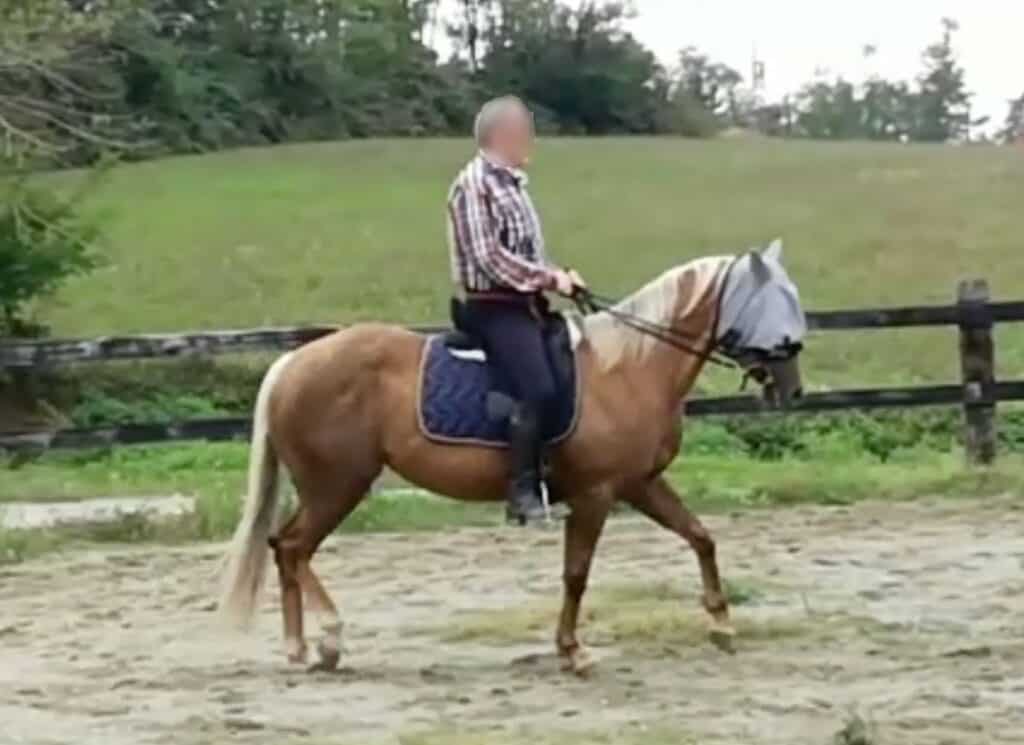
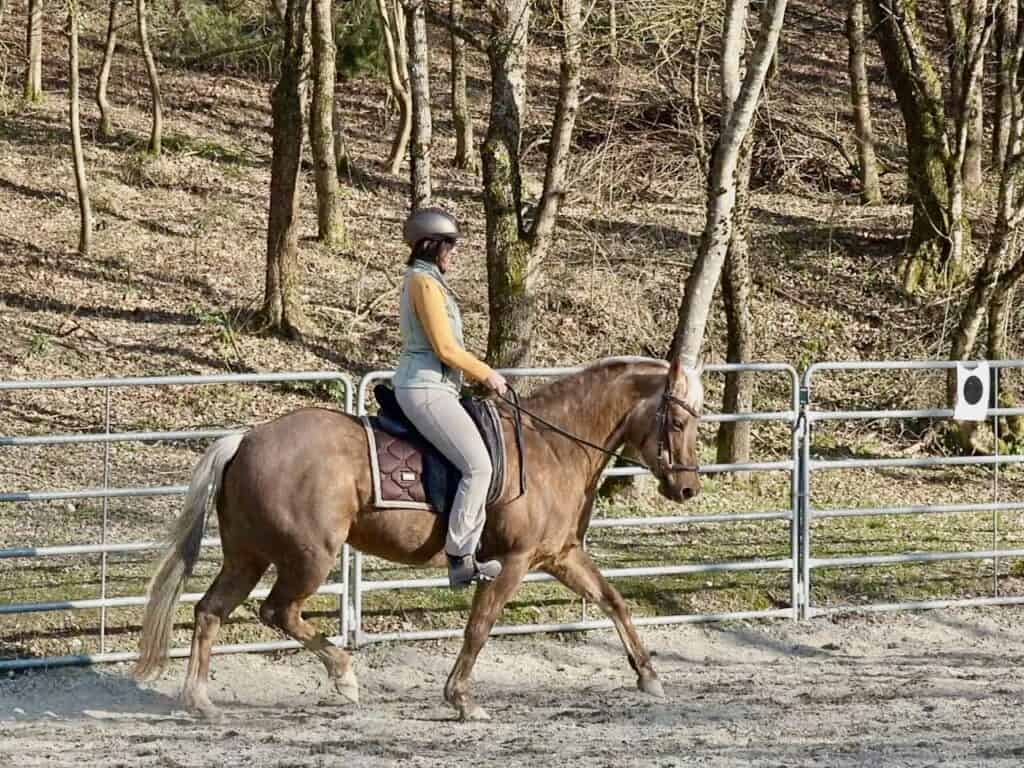
I hope you see the difference between tension with a compressed spine versus a forward movement that flows through the body.
If you do not yet see the difference and want to know how to build this skill, here are my recommendations:
- Learn from Alexandra Kurland who focusses a lot on balance in minute detail. She has developed fabulous teaching material, in particular (but not limited to) her virtual clinic What do you see?
- Get lessons from a Feldenkrais practitioner to feel the effect of small changes in movement
- Watch excellent riders (Anja Beran is one of the few)
- Watch your own training videos and become your own coach.
This is how I developed the skill to recognise quality of movement.
Enjoy the process,
Michaela