Hi,
In the last email, I introduced you to the Feldenkrais-inspired lateral flexions and how you can teach it with a your “listening” hands. Using your hands, you get a better FEEL for this very subtle movement. It will make it easier for you to request it with a similar softness through the lead rope or later through the reins.
I have mentioned that through these micro flexions, you get soft transitions from one exercise to the next.
There is another important reason, why we want to teach and frequently use these flexions and that is BALANCE.
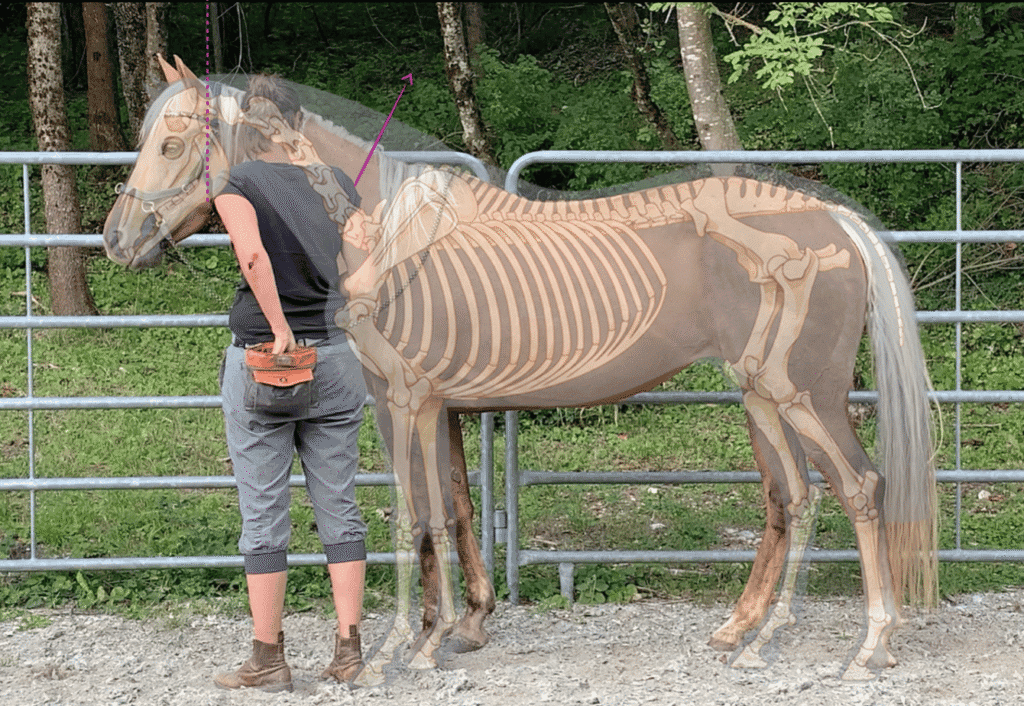
Horses are not symmetrical. They typically put more weight on their front legs and one of them carries more weight than the other. As long as there is no additional weight on them, they don’t get into trouble with this imbalance. But as soon as a rider is on their back, this imbalance is amplified and potentially harmful.
As a responsible rider, you want to teach your horse to carry the same weight on each leg in oder to prevent overloading and lameness.
Flexions are your key instrument to redistribute weight from the overloaded shoulder to the other so both carry equal weight.
Asfaloth shows you how flexions affect shoulder balance.
Anja Beran has an excellent online course that explains these effects and how we can use the lateral movements to straighten the horse and distribute weight evenly on all four feet.
Coming back to our progression, we started out at a halt using our listening hands to get a small give at the jawline. When you get this consistently, ideally on both sides, we can transfer this skill to the halter and lead rope or reins.
Here’s a little clip to show how these requests are connected
With Blondie, it took a lot of patience to be able to work with her in close contact. You have seen her initial reactions. Asking and getting a give, was a game changer for her.
For some horses, it’s easy to get a give during movement, maybe even easier than in a halt. Graya, for example, prefers walking to standing.
For Blondie, on the other hand, the better strategy was to start from a halt and take the flexion into a perfect first step. This also helped to get a lift into that first step instead of a drop forward down, which was a her habitual first step.
I start asking for a give at the jawline and then shape towards a lift of her cervical spine.
I use a shaping technique that Alexandra Kurland ingeniously called “Shaping on a point of contact”.
You slide into a neutral contact, each dance partner in its own balance. From that balance point, even a very subtle balance shift can have a big impact. The procedure is shaping with negative reinforcement but the nuances are so small that you won’t see, or shouldn’t see, negative reactions from your horse.
In case you don’t yet get what you ask for, trying changing something SMALL in your own body: inhale or exhale, turn your shoulder slightly or lift your sternum.
You ask for very little, wait (!) for a response, and after you receive that response, you release, and you can add a click and reinforcer.
Always remember: A give is a small thing.
This is how it looks in practice.
Here is a close up of what I am doing. As I am waiting for Blondie’s response, I am changing small things in my own body, looking for what change helps Blondie finding the desired response.
Should your horse become tense, or “distracted”, then you probably forgot to release or you have asked with too much intensity. Try again, from a point of neutral, with very small shifts of balance.
This fine control from a halt into a perfect step is a lot of fun (as expressed here by Lisa playing with Blondie)
With Malou, we’ll get to these flexions in the context of the various leading exercises. I always focus on this give, especially on her right side, which was a little more stiff.
At this point, I want to show you this view of getting a give from Malou through the reins on the bitless bridle.
Here’s view from the saddle.
Note that I am (foolishly) riding Blondie with two broken fingers, holding the phone in the other hand to film. Idiotic but proving the point that very little pressure is needed.
In the next emails, we’ll go through the many lessons developing excellent leading skills. These are all prerequisites to riding.
Have fun with your horses,
Michaela