Hi,
When the young horse gets comfortable with a rider and understands the basic cues, i.e., go forward, halt, changes of direction, it is time to request a few steps of trot.
There are a number of ways to get there. As you have seen in email 21, requesting trot and canter with a rider on the longe line is an obvious approach. Graya already knew how to trot and canter on the longe and responded to the verbal cues. Adding a rider was only a balance puzzle.
We saw another way to get trot in the last email. Giulia, walking next to Malou, increased the speed of her walk more and more until Malou fell into a trot.
You can use the same approach to get canter, i.e. increasing the speed of the trot more and more until the horse falls into a canter. However, that’s easier on a longe line or ridden as most people have difficulties walking that fast next to the horse 😂.
I am too lazy to run, instead I use mats. If you have done your foundation training well, the mat has become “magnetised” and your horse may actually speed up approaching it. You can use the magnetised mat to build your trot cue.
My horses, especially Graya and Asfaloth, speed up to get to the mat. Here is cute example where I ask Graya for a half pass at liberty. After a few beautiful steps, I release her to the mat and she decides to trot there.
By the way, the half pass increases the chances of a trot as it allows her to stretch her legs (push) after bending her joints (carry) in the lateral movement.
For example, place one or more mats on the track around a circle of cones. As your horse approaches the next mat, she may fall into a trot to get there faster. Land a click on the initiation of the trot, feed and let her go to mat in whatever gait she choses.
When the pattern of trotting to the mat becomes predictable, you can add a cue, e.g., the verbal cue “trot”, just before she starts trotting. Click and treat when you get the trot.
You can then build duration by reducing the number of mats on the track and eventually move the last mat to the centre of the circle. In this case, you can request several rounds of trot (or canter) before inviting her to the mat, click and treat.
Here is an example of building several rounds of canter. The mat is in the centre of the circle.
When these verbal cues are solid on the ground, you can try the same approach from the saddle.
I used that approach with Graya because I had difficulties getting canter departs under saddle. Graya became nervous whenever she anticipated a canter depart. I decided to teach a solid verbal cue on the ground and take that into ridden work.
In the video, you hear my cue for trot (double cluck) followed by the canter cue (“Ready”). In this case, I let her canter a bit more and click on the down transition.
Where you click (up or down-transition) depends on where you are in the training progression.
It worked!
We got canter under saddle with this detour.
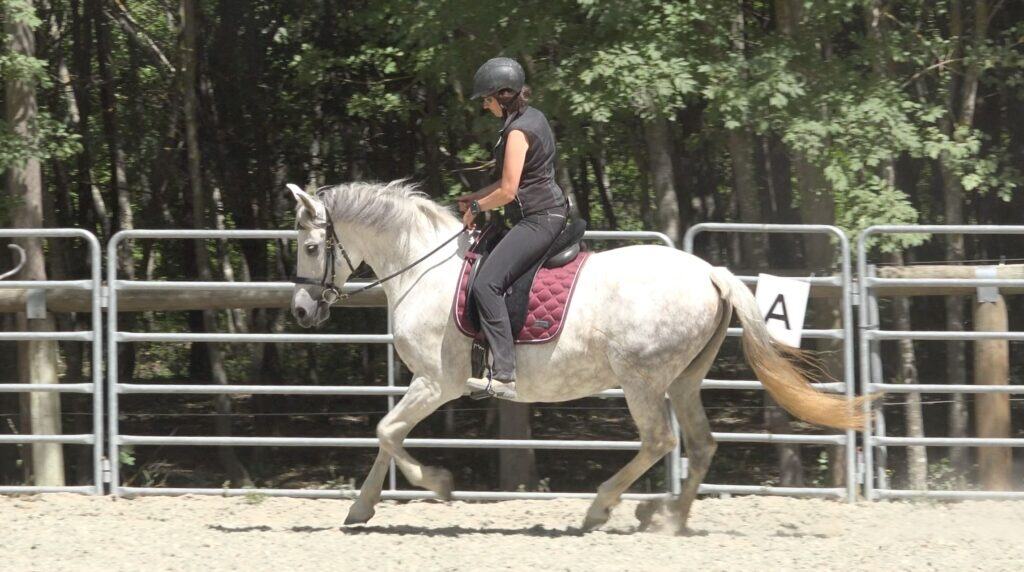
Here’s another fun way of getting the canter: Play hide and seek 😂
As you can see, there are many ways to get forward movement when your horse is ready for it. Play with your horse and she will tell you.
Before closing this email I want to share a personal note on longeing:
When I started with clicker training, I did not want to use longeing. In fact, even though Graya learnt this skill at Anja’s, I still trained her to go around a circle of cones at liberty.
Asfaloth only knows liberty longeing and I regret that I didn’t teach him the longe line because it is useful, e.g., for exercising when you share the arena with other horses or may be required for a veterinary lameness examination. I have started teaching him now, even at 26 years, because I believe it is an important skill.
Longeing can be very aversive, no doubt. So does riding. Riding does not equal riding and the same applies to longeing. It always depends on how you teach and implement it.
Since Blondie had so many issues with the lead rope at first, I did not think that longeing would be the right approach. She was so locked up in her body when she came to us that she couldn’t even run with the other horses through the forest. There was no trot or canter in her.
However, after a while she became more mobile thanks to the balance work and regular turnout. Something changed.
Here’s a spectacular expression of the change in her physical capacity.
After discussing this new development with Anja Beran, I decided to try longeing Blondie. Initially, it wasn’t pretty. Blondie showed head shaking especially before up-transitions. But after a while, it seemed as if she suddenly understood that she has permission to buck and go nuts. After that, something unlocked. The head shaking disappeared and she started to move a lot better.
This taught me a lesson: Don’t judge a procedure or application on principle. There is always more nuance and depth to discover. The horse will give you the answer.
As Alexandra Kurland likes to say:
Go to people for opinions and to horses for answers.
Longeing can be extremely harmful, especially when done with fixed reins and at high speed, but it can also be beneficial. Just like riding. It is much more complex than simply categorising it as “good” or “bad”.
The next email will wrap up this series.
Happy training,
Michaela