Hi,
Before we dive in, let’s recap what we have done so far.
My goal is to work with Blondie at liberty in the arena (question 1).
To build that skill, I went through a systematic process to identify our starting point (question 2).
We identified the foundation lesson’ Standing on a mat’ as our stepping stone and expanded on that in an environment where Blondie feels safe.
Blondie learned to go from mat to mat independently of where I was going. Then I introduced cones to the training environment and made them more relevant by moving them gradually into her path.
That’s where we left last time.
Now that I have a fluid base behavior, I tested whether I could take it to the arena.
Would it be solid enough for such a drastic environmental change?
It worked! 💪
This process is beneficial for other situations as well. For example, if your horse is nervous in the arena, for instance, because he’s away from his friends, you could establish the pattern close to others where he is still calm and then move the pattern gradually towards the arena.
At each step, ensure that calmness is maintained. Then, if he gets tense, go back to a point where he can be relaxed.
Before continuing with Blondie’s training, let’s focus a little bit more on the principles applied here.
Stimulus shaping (Fading)
I first learned about stimulus fading when Mary Hunter gave a great talk on errorless learning during the first Science Camp 2019 at our barn in Italy.
Mary introduced us to Herbert S. Terrace, who, in the 1960s, developed a new method later termed errorless learning.
Terrace successfully trained pigeons red-green discrimination without the occurrence of any errors (Terrace 1963a).
Initially, a red key was presented with full brightness and duration, whereas a green key was dark and presented only briefly. Gradually, the brightness and duration of the green key increased until reaching similar values.
The pigeons learned the red-green discrimination with no or few incorrect responses. Moreover, they showed no “emotional” responses, such as wing flapping and striking the key, in the presence of the green light, which he interpreted that the signal indicating ‘no reinforcement’ did not become aversive.
In a subsequent study, again with pigeons, Terrace, 1963b accomplished an errorless transfer from the red-green discrimination to discrimination between a vertical and a horizontal line by first superimposing the vertical and the horizontal lines on the red and green backgrounds, respectively, and then fading out the red and the green backgrounds.

Ingenious!
Here’s a fantastic errorless learning application that Mary also presented.
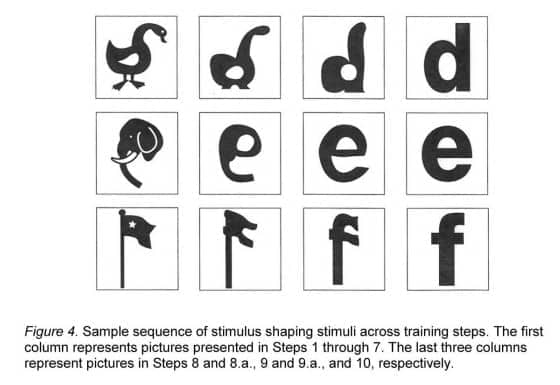
Larisa Ann Maxwell, MSc student of Jesús Rosales-Ruiz at UNT, evaluated the benefits of an errorless learning procedure to teach letter discriminations to preschool children. She used stimulus shaping, transforming an image that the child could name, e.g. “duck”, “elephant”, to a letter “d-duck”
You can apply the same principles to teach complex materials such as Neuroanatomy (Sidman, R. L., & Sidman, M. (1965). Neuroanatomy: A programmed text (Vol. 1). Lippincott Williams & Wilkins.)

Back to horse training – building the cone circle
You can fade objects in or out (stimulus fading), as Terrace’s lines over the fading color, or you can change the object’s topography (stimulus shaping), as Maxwell’s images to letters.
If done well, your learner will master the new skill without effort and frustration.
And as likes to Mary point out:
“Making learning easy is not cheating!”
It’s excellent teaching.
In the mat circle example, I faded in the cones. Initially, they were irrelevant. By changing their position, they became “visible” and became relevant.
Now I could use that same setup and fade out the mats, and Blondie would go around the cones until I click or cue something else.
I could also fade out the cones altogether, and I get liberty lungeing.
That’s an elegant progression.
Another approach could be to use a barrier to keep the horse on a circle and then fade out that barrier, e.g., by lowering it gradually towards the ground, leaving empty spaces and eventually dissolving it completely.
I want to fade out the barriers, which allows me to use the circle, e.g., turning in and out of the circle. A balanced turn around a cone is a great gymnastic exercise.
You can use a mat in the center to reinforce, e.g., a turn. It also helps to get an engaged forward turn instead of a disengaged backward turn, as the horse wants to get to the mat.
I like to keep the cones because they are an excellent teaching tool.
Another way to train liberty lungeing
After that winter, I revisited the lesson and chose an even more systematic variation to teach Blondie going around the cones.
It still builds on ‘Standing on a mat’ and thanks to the previous work, we can start directly in the arena.
This approach also teaches important cues for liberty lungeing, such as sending her out, staying out, and coming back into the circle.
In the following emails, I will share that training plan and you can follow along with your own horse, if you like. Let me know how it works.
But that’s for the next email.
Today you already got a lot of material to digest.
Enjoy studying the material,
Michaela