Hi,
Everything is ready to get on your horse. She leads well, knows how to walk on, come to a halt and yield her hips. If you want to use a saddle, she has experienced and is comfortable with it.
But there is one more important consideration BEFORE getting on your horse’s back:
What are you going to do once you are actually in the saddle?
When you are on your horse’s back, you are no longer on the ground. Seems obvious but people forget that this changes everything from the horse’s point of view.
Not only is there a strange weight on her back that takes her off balance but you have also disappeared from her side.
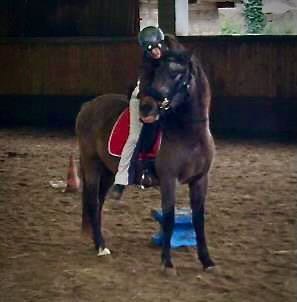
Getting on your horse’s back is a critical moment. This first experience will influence your horse’s riding career possibly for the rest of her life.
There are several things to consider to ensure a positive and SAFE first experience.
Life happens and things can go wrong. That’s when the experience of a professional trainer is invaluable.
The more young horses a professional has started, the more unexpected events she has encountered. With this knowledge, she can prepare for the unexpected.
When a rider gets on the first time, the young horse may spook and jump forward even though she is well prepared. A scared rider may grab with hands and legs or fall and scare the horse even more.
Ideally, the young horse remains relaxed throughout. Everything is going as planned until suddenly a dog runs across the field or a bird drops dead in front of her.
True story:
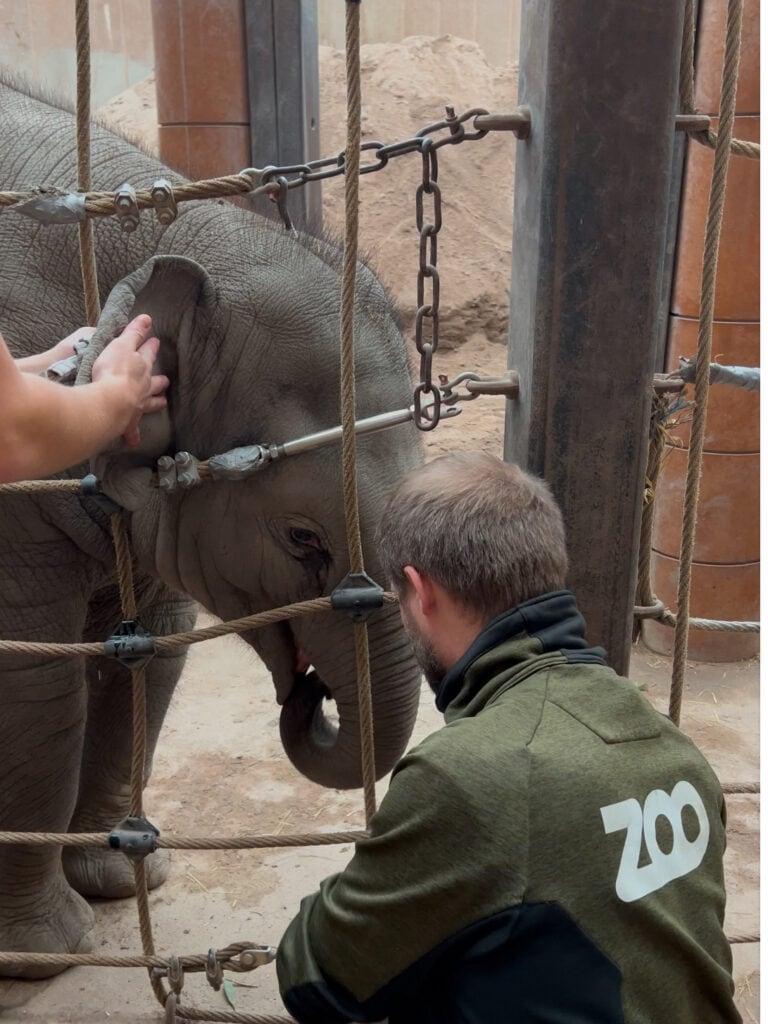
Copenhagen Zoo training coordinator Annette Pedersen showed me a video of the first voluntary blood draw training of a baby elephant. Everything went smoothly until suddenly a bird dropped dead in front of the elephant who spooked and ran back to the family. What are the odds?
(The baby came back and they continued the training.)
Let’s assume, everything goes as planned, no unfortunate bird falling from the sky.
You get on your horse. And now what? Your horse may well be rather confused about what to do next. You have not yet developed a communication system for riding.
For all these reasons, for safety and clarity, I strongly recommend the assistance of at least one helper from the ground for this critical training step.
Should the unexpected occur, the ground person is there for the safety of horse and rider. And she can guide the horse from the ground while experiencing a person on her back preventing confusion.
Graya getting started under saddle by Anja Beran
Graya had the privilege of getting started under saddle by Anja Beran. I experienced her approach first hand. Anja proceeds systematically and carefully, preparing for all kinds of unexpected events.
And she appreciates the privilege of receiving the horse’s permission to get on their back.
“Always remember that you are a guest on your horse’s back.”
~ Anja Beran
I will try to summarise Anja’s progression using Graya’s example but I highly recommend attending her annual workshop to get the full picture (and join fellow clicker trainers on this occasion 😉 – send me an email to know more).
Graya learned to walk, trot and canter on the longe line. Anja starts this in her beautiful round pen. The walls help the young horse to stay on a circle line. This requires two persons, one in the centre holding the longe line and a second to walk behind her with a longe whip to prevent sudden turns.
Graya learned to respond to verbal cues, i.e. up and down transitions, and halt staying on the track.
When the longeing works well, the saddle is introduced in the arena, never in the stall, so the young horse can move if she wants to. This step requires a third person who receives the saddle on the other side and helps placing it carefully on the youngster’s back.
The girth is closed very carefully and sequentially with a few walking rounds in between.
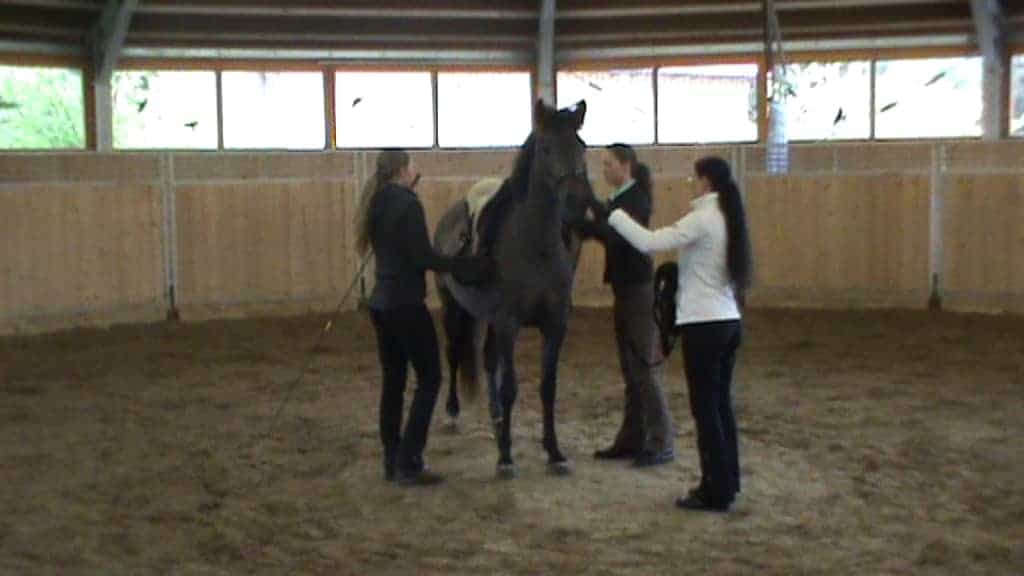
Anja then longes the young horse with the saddle in all gaits to make sure that she is comfortable moving with the saddle on her back.
From there Graya gets acquainted with the indoor school. Anja lets the young horse run freely in the arena with at least three persons on the centre line to guide the horse on the track, circle or change across the diagonal. This requires very good coordination between the three people to guide the horse through these patterns smoothly.
Then Graya learned to longe in the arena which requires even more helpers: the “longe master” and an assistant following the horse and then another 1-3 persons with longe whips that act as “wall” on the open side to help Graya stay on the circle line.
At a later stage, Anja pulls down the stirrups, so the horse gets used to feeling something touching her sides as she moves.
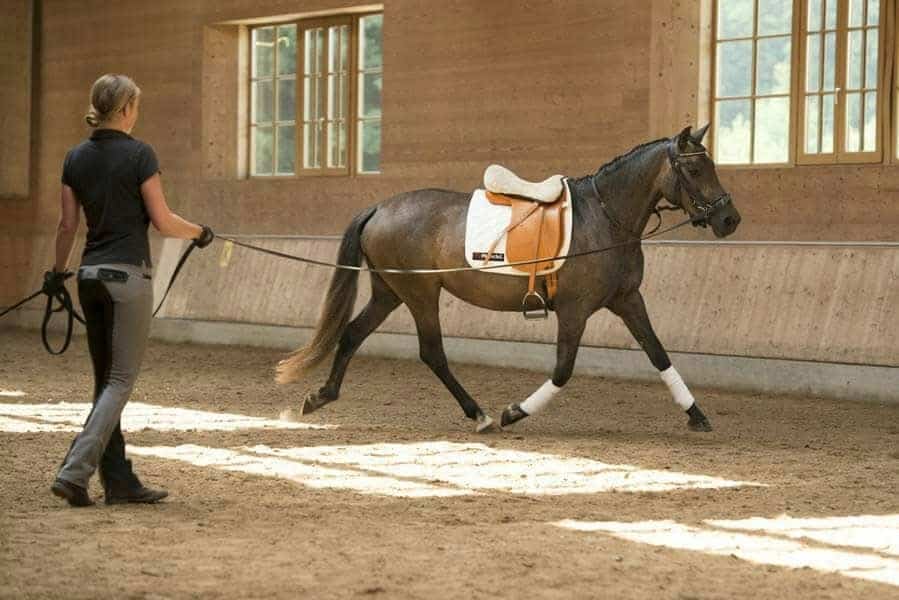
When the horse is comfortable with all that and responds reliably to the cues from the ground person, a rider is introduced. Initially, the rider is only a passenger, the horse is still guided from the ground person.
In the next video clip, you will see young Graya experiencing weight of a rider on her back. Before that, she was longed in the arena. This requires again plenty of helpers: 3 around the horse and another 1-3 “wall” simulators.
All these precautions are implemented to prevent errors as much as possible.
In case you are wondering, Graya had a small injury at her left hind leg which is entirely my fault. It happened during the training for trailer loading just before travelling to Anja due to a design flaw of the ramp 😟.
In the next clip, you see the rider getting on. Graya was still very small and struggled a little to keep the balance. You can see how Graya needs to stand wide to keep the balance.
Anja acknowledges this difficulty and only asks what Graya is able to do. In fact, in the clip Anja tells me that she cannot proceed any faster because Graya needs to solve this balance puzzle first. Fine with me ☺️
When the mounting and first steps with rider go smoothly, they proceed with longeing.
On the longe line, the young horse is asked to walk, later trot and, much later, to canter with a rider.
When that works, a transfer of cues is programmed. The rider presents the cue first, followed by the ground person, until the horse responds to the rider’s cue. In clicker training terms, this is a “New cue – old cue” procedure.
In the next clip you see how the rider begins to cue Graya from the saddle with the help from the ground persons.
Anja then systematically introduces other lines in the arena that Graya will eventually do alone under the rider, e.g. on the track, turns, diagonals. First with the help from the “longe master” with assistant and later alone with the rider.
With such a careful, systematic and errorless progression, Graya could confidently present her newly acquired skills at the International Classical Dressage Workshop in 2013 without the help of a longe line 🤩
One big advantage of this progression is that forward movement is integrated from the beginning without compromising safety.
I strongly believe that maintaining the “forward” that young horses already bring with them into the training, is one of the most important elements in training.
So many problems we try to solve later on are related to the lack of “forward”.
What is forward? It basically means “on the aids” in equestrian terms. It means that you can request a change or transition from your horse in any direction at any moment. You ask and get an up-transition or down-transition, or backing or lateral movement without hesitation.
Anja says that on a continuum of “forward”, the levade is the highest expression of forward and a rear is the least forward.
Topographically similar, but a rearing horse is the opposite of forward. It is blocked and tries to escape from what it is asked to do.
On the other hand, only a highly collected and balanced horse can offer a good levade such as the one offered by Anja’s Lusitano Olé, who turns 30 years in 2025!
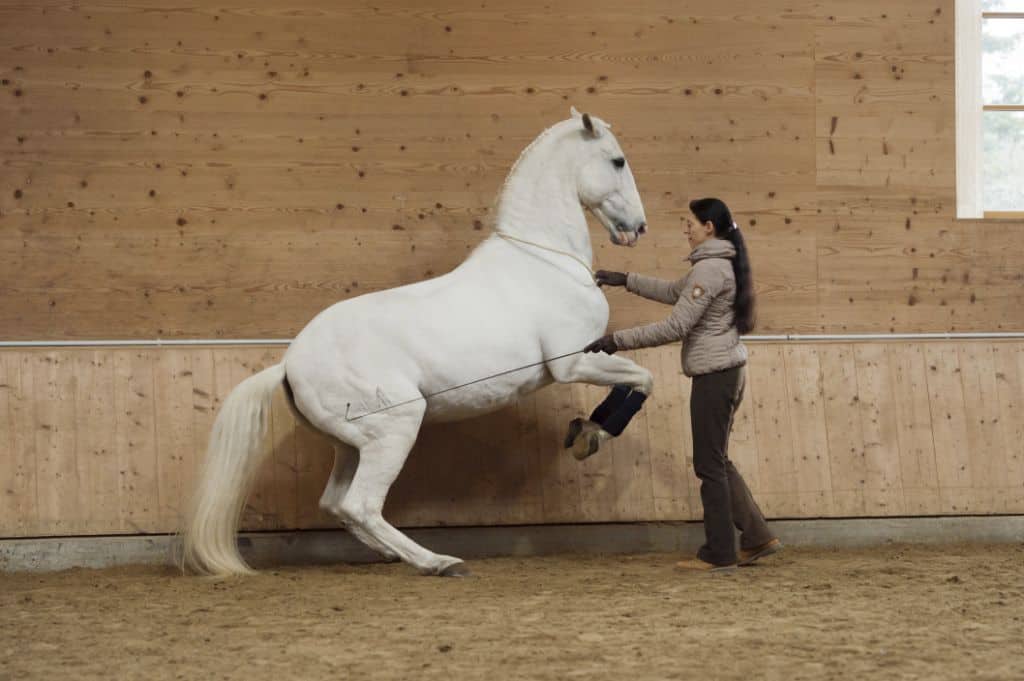
Understanding and fostering “forward” is crucial when starting a horse under saddle and, unfortunately, many trainers, including professionals, too often underestimate or misunderstand it.
This is the very important lesson that Anja teaches us and why everyone who is training horses should watch her train. I can’t recommend that enough.
Don’t get hung up by procedures or tools. Yes, Anja is using traditional trainings methods (extremely well!) and, yes, she uses whips and spurs. BUT, she does not need get loud with them because she is so clear in her signals and prepares the horse so well before asking, that the horses are able and willing to respond. Her training is kind, fine and clear.
Fun fact: Anja participated in an experiment measuring rein tension. Her contact with the horses mouth was so light, that the experimenters thought the equipment was faulty because they have never measured such a light contact.
Watch her horses and you will know that she is someone you want to learn from. You can find videos on Anja’s website, Facebook, Instagram and Youtube accounts. In the P.S., I added a video I made for Anja in 2018 to spread her Workshop to a wider audience.
The difficulty many of us face is that we typically do not have so many helpers. Most of us work alone.
Clicker training helps with that. We can teach many of the prerequisites which allow us to proceed safely despite lack of helpers. We can use e.g., mats to get forward and we can create situations that allow us to interpret the horse’s approach to the mounting block as an invitation to get on.
In the next email, I will share with you, how we integrated the lessons from Anja with clicker training to start Malou under saddle.
Michaela
P.S.:
Here is an impression of the 2018 workshop. Send me an email if you want to join the next one.